This section will provide information on the peace process and potential solutions.
The Peace Talks section, under the history tab, addresses the history of the peace process.
The Resistance section addresses the many international and grassroots efforts being made to help bring peace to Israel and Palestine.
Why Hamas is Not the Issue – Gaza: History Matters Elaine C. Hagopian, CounterPunch - How does one explain the horrific fate that has befallen caged Gaza – a land saturated with rubble and body parts – carpet-bombed by air, invaded by ground, attacked by sea? Put to the test of history, Israeli “explanations” fail the credibility test. more
Letter to the Editor of the Atlanta Journal-Constitution: Allowing the terrorists to win Retired Brigadier General James J. David - In describing how the civilized world has failed in its attempt to deal with terrorists, Jay Bookman states that " In the Middle East, Palestinian terrorists have attacked repeatedly in hopes of disrupting peace efforts," ( "Time after time, we have allowed the terrorists to win," A20, Dec.4.) more
Divide and Rule, Israeli-Style Jonathan Cook in CounterPunch – The boycott by Israel and the international community of the Palestinian Authority finally blew up in their faces with Hamas' recent bloody takeover of Gaza. Or so argues Gideon Levy, one of the saner voices still to be found in Israel. "Starving, drying up and blocking aid do not sear the consciousness and do not weaken political movements. On the contrary Reality has refuted the chorus of experts and commentators who preached [on] behalf of the boycott policy. This daft notion that it is possible to topple an elected government by applying pressure on a helpless population suffered a complete failure." But has Levy got it wrong? more
Saving President Abbas Uri Avnery – Ehud Olmert is the opposite of Midas, King of Phrygia. Everything the king touched turned into gold, according to Greek legend. Everything Olmert touches turns into lead. And that is no legend. more
A political marriage of necessity: a single state of Palestine-Israel Ali Abunimah, Christian Science Monitor - As Israel celebrates 59 years of independence, Palestinians on May 14 commemorate the Nakba, the catastrophe of expulsion and decades of exile that continue to this day. When my mother was 9 years old, she and her family mounted the back of a pickup truck and left their village of Lifta, adjacent to Jerusalem, under threat from Zionist militias. My grandmother covered the furniture in the family home that my grandfather had built. Anticipating a short absence until fighting in the area died down, they took only a few clothes. That was almost six decades ago. Like hundreds of thousands of other Palestinians, they were never allowed to return, and their property was seized by Israel. more
Commentary: Why does The Times recognize Israel's 'right to exist'? Saree Makdisi, Los Angeles Times - 'AS SOON AS certain topics are raised," George Orwell once wrote, "the concrete melts into the abstract and no one seems able to think of turns of speech that are not hackneyed: Prose consists less and less of words chosen for the sake of their meaning, and more and more of phrases tacked together like the sections of a prefabricated henhouse." Such a combination of vagueness and sheer incompetence in language, Orwell warned, leads to political conformity. more
Speaking frankly about Israel and Palestine Jimmy Carter in the Los Angeles Times - I signed a contract with Simon & Schuster two years ago to write a book about the Middle East, based on my personal observations as the Carter Center monitored three elections in Palestine and on my consultations with Israeli political leaders and peace activists. We covered every Palestinian community in 1996, 2005 and 2006, when Yasser Arafat and later Mahmoud Abbas were elected president and members of parliament were chosen. The elections were almost flawless, and turnout was very high – except in East Jerusalem, where, under severe Israeli restraints, only about 2% of registered voters managed to cast ballots. more
Does It Matter What You Call It? Genocide or Erasure of Palestinians Kathleen and Bill Christison - During an appearance in late October on Ireland's Pat Kenny radio show, a popular national program broadcast daily on Ireland's RTE Radio, we were asked as the opening question if Israel could be compared to Nazi Germany. Not across the board, we said, but there are certainly some aspects of Israel's policy toward the Palestinians that bear a clear resemblance to the Nazis' oppression. Do you mean the wall, Kenny prompted, and we agreed, describing the ghettoization and other effects of this monstrosity. Before we could elaborate on other Nazi-like features of Israel's policies, Kenny moved on to another question. Within minutes, while we were still on the air, a producer handed Kenny a note, which we later learned was a request from the newly arrived Israeli ambassador to Ireland to appear on the show, by himself. Several days later, on the air by himself, the ambassador pronounced us and our comparisons of Israeli and Nazi policies "outrageous." more
Carter shares insight on peace in Mideast Marty Rosen in the Louisville Courier-Journal - Former President Jimmy Carter's new book, "Palestine -- Peace Not Apartheid," reflects a lifetime of contemplation on the Middle East. Mixing memoir and policy, it recounts his youthful fascination with the Holy Lands, his long acquaintance with the political leaders who have shaped the modern history of the Arab and Israeli worlds, and it makes a strong case for renewed debate about the best path to peace in a long-troubled part of the world. In a telephone interview, Carter spoke in detail about the history of the Israeli-Palestinian conflict and his hopes for peace. Here are his unedited responses: more
Commentary: The Truth You Don’t Hear Mustafa Barghouti in Al-Ahram Weekly - What is the current situation on the ground in Palestine? The Israeli narrative that continues to dominate the international media presents an image that is absolutely at odds with reality. The Gaza redeployment was spun as the beginning of a peace process; a great retreat by General Ariel Sharon, who was portrayed as a man of peace. Yet the fact remains that Palestine is 27,000 square kilometres, of which the West Bank constitutes only 5,860 square kilometres, and the Gaza Strip, just 360 sq km. This is equal to only 1.3 per cent of the total land of historic Palestine. So even if Sharon really had withdrawn from Gaza, this would amount to just 5.8 per cent of the occupied territories.
more
Israel redraws the roadmap, building quietly and quickly Chris McGreal in the UK Guardian - At the northern edge of Jerusalem, on the main road to the Palestinian city of Ramallah, three towering concrete walls are converging around a rapidly built maze of cages, turnstiles and bomb-proof rooms. When construction at Qalandiya is completed in the coming weeks, the remaining gaps in the 8m (26ft)-high walls will close and those still permitted to travel between the two cities will be channelled through a warren of identity and security checks reminiscent of an international frontier.
more
Fortress Israel Ilan Pappe in the London Review of Books - The right of the Palestinian refugees expelled in the 1948 war to return home was acknowledged by the UN General Assembly in December 1948. It is a right anchored in international law and in accordance with notions of universal justice. More surprisingly perhaps, it also makes sense in terms of realpolitik: unless Israel agrees to repatriate the refugees, all attempts to solve the Israel-Palestine conflict are bound to fail.
more
U.S. accused of pro-Israel bias at 2000 Camp David Nathan Guttman in Haaretz - A member of the U.S. peace team during the 2000 Camp David talks has accused the United States of adopting a distinct pro-Israeli policy that, together with other mistakes, led to the failure of the negotiations between Ehud Barak and Yasser Arafat.
more
E-1: The End of a Viable Palestinian State Jeff Halper in The Electronic Intifada - The fatal flaw in most analyses of the Israel-Palestine conflict is the assumption that if the Palestinians can just get a state of their own, then all will be fine. A state on all the Occupied Territories (UN Resolution 242), on most of the Occupied Territories (Oslo and the Road Map to the Geneva Initiative), on even half the Occupied Territories (Sharon’s notion) – it doesn't matter. Once there’s a Palestinian state the conflict is over and we can all move on to the next item on the agenda.
more
EU: Israel Breaching Road Map Al Jazeera - The European Union’s foreign policy chief has accused Israel of breaching the international community’s road map for Middle East peace by moving to expand the biggest settlement in the occupied West Bank.
more
How Much is Enough? Khaled Amayreh in Al-Ahram Weekly - As Palestinians agree to a general cease-fire Israel announces it will steal yet more land, reports Khaled Amayreh in the West Bank.
more
How Israel Is Once Again Redefining the Terms of Peace Ramzy Baroud - The recent and supposedly ‘successful’ Sharm el-Sheikh summit in Egypt on February 8 was anything but a triumph, as far as Palestinians, the occupied party, and genuine peace-seeking Israelis are concerned.
more
Abbas, Sharon declare end to violence Aljazeera - Palestinian President Mahmud Abbas and Israeli Prime Minister Ariel Sharon have announced the end of four years of violence at a landmark summit in Egypt, setting the stage for a full-scale revival of the peace process.
more
In Arafat’s Aftermath Professor George E. Bisharat in the San Francisco Chronicle - As Yasser Arafat has died, so die the hopes for a two-state solution to the Palestinian-Israeli conflict. Contrary to the belief held in the United States and Israel, Arafat worked tirelessly toward the “peace of the brave” and the establishment of a Palestinian state alongside Israel. It was precisely because Arafat was such a dogged proponent of compromise with Israel that the Israeli government worked so hard to destroy him.
more
Sharon’s Banana Republics Afif Safieh in The UK Guardian - The study of American-Israeli relations has preoccupied two generations of scholars. Two competing schools of thought addressed the “who wags whom” debate. The first school spoke of “an American Israel”, with the United States dictating to the local ally its regional policy in accordance with the American global vision. The second school projects the image of “an Israeli America”, a complex relationship where the global superpower adopts the regional policy of its client state and integrates it in its global strategy. This is seen as a result of a powerful pro-Israel lobby that succeeded in turning “Capitol Hill into another Israeli-occupied territory”.
more
Opinion: Palestine is now part of an arc of Muslim resistance Seumas Milne in the UK Guardian - Ariel Sharon’s decision to incinerate a 67-year-old blind quadriplegic cleric outside his local mosque will certainly go down as one of the most spectacularly counter-productive acts of violence in the history of the Israel-Palestine conflict.
more
Beyond Road Maps and Walls Professor Jeff Halper in The Link - The process of achieving a viable peace in the Middle East is, I believe, a two-stage process. First, to resolve the Israeli-Palestinian conflict. The feasibility of different political options must be examined in terms of the “facts on the ground” imposed by Israel. Second, to address the underlying elements that would otherwise destabilize and frustrate attempts by Palestinians and Israelis to reach an equitable accommodation. This requires a regional approach to bringing peace, democracy, and development to the Middle East.
more
Right of Return: Two-State Solution Again Sells Palestinians Short Professor George Bisharat in the Los Angeles Times - It is a tragic irony that, more than 55 years ago, one desperate people seeking sanctuary from murderous racism decimated another — and continue to oppress its scattered survivors to this day. In 1948, about 700,000 Palestinians were expelled from their homeland, their land and possessions taken by the new Jewish state of Israel. This included the Jerusalem home of my grandparents, Hanna and Mathilde Bisharat, which was expropriated through a process tantamount to state-sanctioned theft.
more
Israeli Settlements ‘Still Expanding’ Unchecked Jonathan Cook in Arab News - sraeli settlements are still being established in Palestinian territory according to Israeli peace activists; and dismantling operations are, say the activists, a charade, even though an end to their expansion is a key feature of the US-backed road map to Middle East peace.
more
Israel Announces New Settlement Plan Ravi Nessman of AP - Israel announced Thursday it would build 565 new homes in Jewish settlements in the West Bank, violating a U.S.-backed peace plan and angering Palestinians already seething over plans to build a security barrier deep into the West Bank.
more
A Roadmap to Nowhere Former CIA analyst Kathleen Christison in Counter Punch - The “roadmap” to peace between Israel and the Palestinians, finally released with little fanfare or enthusiasm on May 1 after almost a year of aimless wandering, is surely doomed. Near fatal internal flaws and severe political constraints on its implementation render it a roadmap to nowhere, destined for the same junk yard where the Mitchell Plan, the Tenet Plan, and the Zinni Plan have rusted for the two years of the Bush-Sharon stewardship over the so-called “peace process.”
more
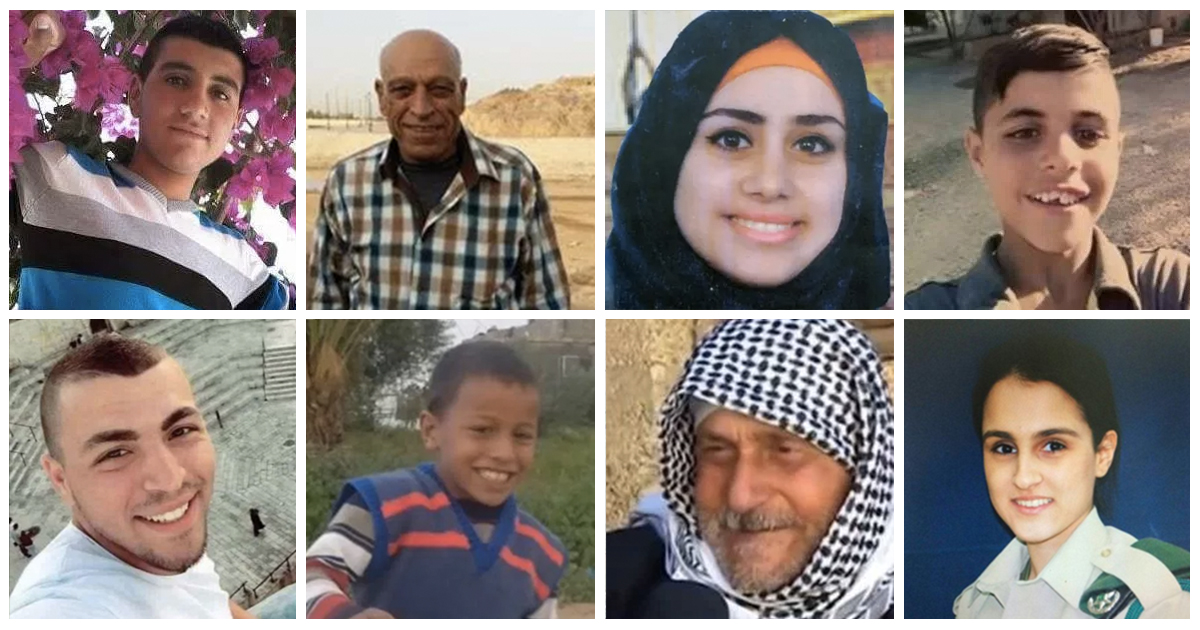
Israel-Palestine Timeline: The human cost of the conflict records photos and information for each person who has been killed in the ongoing violence.
History of the Israel Lobby
Alison Weir's book Against Our Better Judgement: How the U.S. was used to create Israel brings together meticulously sourced evidence to outline the largely unknown history of U.S.-Israel relations.